A safety switch, an RCD, is the only device in your house designed to protect a person rather than the wiring. If yours have never been tested, or if you are not sure you have any, use the quote form above and have someone check.
What is the difference between a safety switch and a circuit breaker?
A circuit breaker protects the cable. When too much current flows, an overloaded circuit or a short between conductors, it opens before the wiring overheats. That is genuinely important, and it is why houses stopped burning down as often, but it does nothing for you. Enough current to kill a person is a tiny fraction of what it takes to trip a breaker.
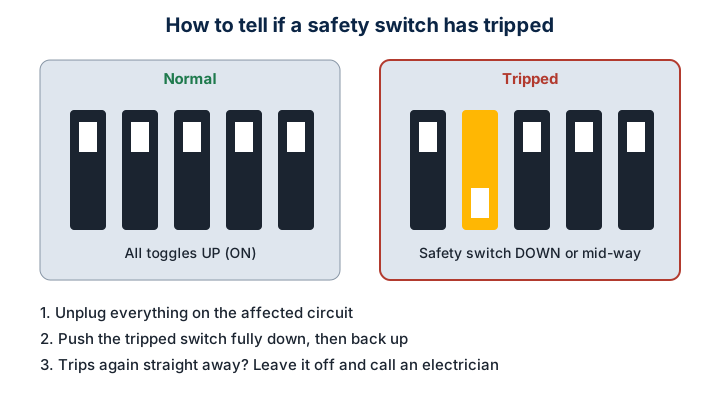
A residual current device compares the current flowing out along the active with the current returning along the neutral. If those figures do not match, current is leaving the circuit somewhere, through damp insulation, a faulty appliance, or a person touching something live, and the device opens in well under a second at a leakage of around 30 milliamps. That is the whole design intent: to disconnect before a shock becomes fatal. An RCBO does both jobs in one unit, per circuit, which is why modern boards are built from them.
You can tell them apart by the test button. RCDs and RCBOs have one; plain circuit breakers do not. If you open your board and nothing has a test button, you have overload protection and no shock protection, which describes a great many houses across Croydon, Mooroolbark, Kilsyth and Mount Evelyn built before the mid-1990s.
How often should safety switches be tested?
Press the test button on each device roughly every three months. It should trip immediately; reset it and you are done. That test proves the mechanism still operates, and it takes a minute. What it does not prove is that the device trips fast enough or at the right leakage current, which requires an instrument and is part of a proper electrical safety check.
RCDs are mechanical devices and they age. A unit that has sat untouched in a hot switchboard for fifteen years may pass a button test and still fail to operate correctly under a real fault. That is not an argument for skipping the button test. It is the reason the button test alone is not enough.
Electrical safety checks for rental properties in Victoria
Victorian rental providers have specific obligations here. Under the residential tenancy rules, an electrical safety check of all electrical installations, fixtures and fittings must be carried out by a licensed or registered electrician at least every two years, the record of that check must be kept, and it must be produced to the renter on request. All switchboards in rental properties must have RCDs fitted. If a property has never had a check, or the last one was more than two years ago, the check is due now rather than at the next lease change.
For rental providers and agents managing properties across Lilydale, Chirnside Park, Croydon, Ringwood and the valley towns, the practical approach is to have the check and any remedial work quoted together, so that a board without RCDs is not discovered on the day the compliance record is needed. A contractor doing these routinely will provide the check record in the form your agent expects.
What gets looked at in a safety check?
The switchboard first: what protection exists, whether the main switch and RCDs operate correctly under test, whether circuits are identified and labelled, and whether there is any sign of heat damage, moisture or unauthorised work. Then the earthing system: the main earth conductor and the bonding to metallic water and gas services, which is one of the most commonly disturbed items in a house that has had plumbing replaced, because a plastic section installed mid-run can quietly interrupt a bond.
Then the visible installation: power points and switches for damage, heat marks or looseness, light fittings and their mounting, exhaust fans, outdoor outlets and their weatherproofing, sheds and outbuildings and how they are supplied, and smoke alarms: their type, age and whether they are still within life. Anything found unsafe is reported to you, and anything that must be made safe immediately is dealt with on the spot rather than written down for later.
Other electrical work in the Yarra Valley
The same contractors cover the rest of the list. Start at the Electrician Yarra Valley home page for the full picture, or go straight to what you need.
Or find your suburb
Frequently asked questions
Are safety switches compulsory in Victoria?
RCD protection is required on final subcircuits whenever a switchboard is upgraded, and all rental properties must have RCDs fitted at the switchboard. There is no rule forcing an owner-occupier with an untouched old board to retrofit them, which is exactly why so many older homes across the Yarra Ranges still have none.
How often do Victorian rental properties need an electrical safety check?
At least every two years, carried out by a licensed or registered electrician, covering all electrical installations, fixtures and fittings. The rental provider must keep the record and give it to the renter on request.
My safety switch trips when it rains. Why?
Almost always water finding its way into something outdoors: a garden light, an outdoor power point with a failed seal, an underground cable joint, a shed circuit, or a pump. It is a real fault, not a quirk of the device, and it is the RCD doing precisely what it is for. It is usually straightforward to locate by isolating circuits one at a time.
Can I test a safety switch myself?
Yes, and you should. Press the test button on each RCD about every three months and confirm it trips. That is a homeowner job with no risk. What needs an electrician is verifying the trip time and current with an instrument, which is the part that catches a device that clicks on the button but would not save anyone.
Ready to get it sorted?
Use the quote form at the top of this page to tell a licensed electrician about what protection you have now and what is missing, and they will call you back.
No obligationRequest a free quote